


August 20, 2019
Investing 101
Do US Industry-Sector Weights Explain the Higher Valuation of US vs non-US Equities?
Global equity market Investors are acutely aware of the tremendous outperformance of US equities versus non-US equities over the past ten years, as illustrated in the chart below.
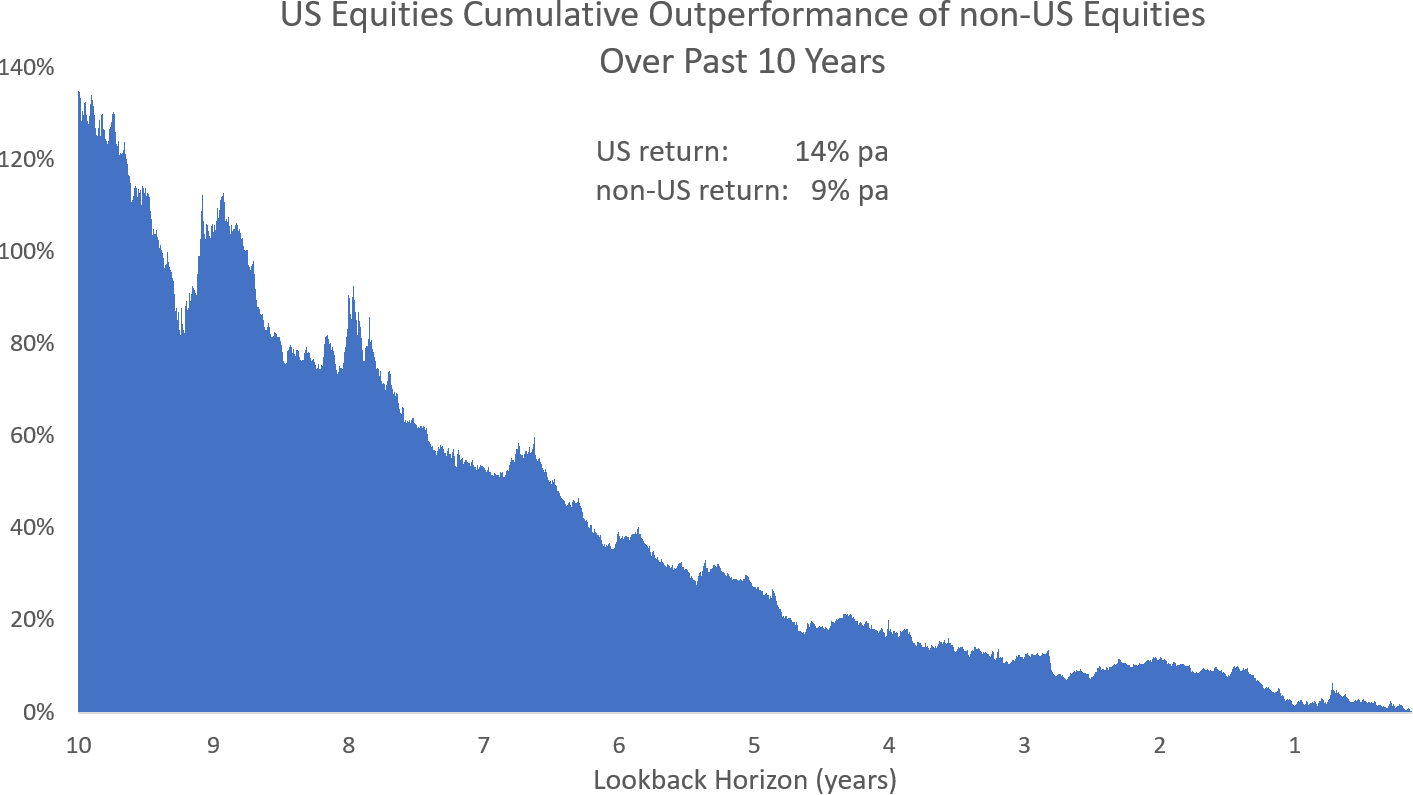
About 2/3 of this 135% cumulative outperformance is accounted for by higher earnings per share growth of US versus non-US equities.1 The remaining 1/3 is attributable to the relative change in earnings multiples, leaving the one-year trailing Earnings Yield of US equities at 4.9%, 2% lower than the 6.9% for non-US equities.2 The difference in the 10-year cyclically-adjusted Earnings Yield is even wider, at roughly 3%.
In a recent conversation we had with Seeking Alpha founder David Jackson, he posed a good question: to what extent could the difference in Earnings Yield between US and non-US equities be explained by US market-cap indices being more heavily weighted towards technology companies with high growth potential, while non-US markets lean towards lower-growth natural resource and financial companies? And if sector differences do explain much of the differential Earnings Yield, might we conclude that non-US equities may not in fact offer substantially higher long-term expected returns? 3
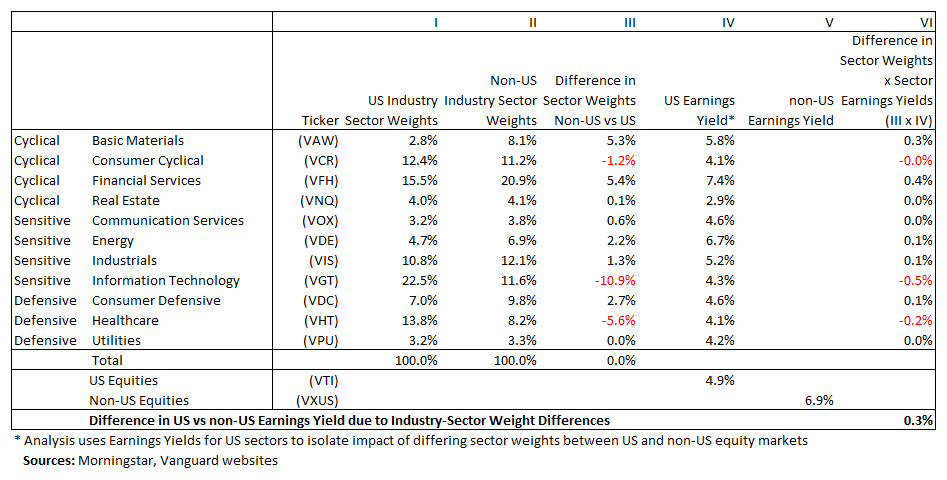
The table below addresses this question. Indeed, the US stock market has a 10.9% heavier weight than the non-US stock market in Information Technology companies, trading at a PE of 23.4x, counter-balanced by a roughly 11% lower weight in Basic Materials and Financial Services, trading at a significantly lower PE of about 15x. However, the differences in weights and PEs aren’t enough to explain much of the total difference in Earnings Yields between the broad US and non-US markets. We arrive at this conclusion by applying US industry-sector Earnings Yields to both US and non-US sector weights, and finding the difference in sector weights only accounts for 0.3% of the 2% difference in Earnings Yields between the broad US and non-US equity markets, as shown in bold in the table below.
Of course, it’s possible that a deeper dive into the growth prospects of each US and non-US sector might explain more of the difference in Earnings Yields. But, given that sector-makeup differences don’t seem to materially drive total-market Earnings Yield differences, perhaps it’s more likely that the higher valuation of the US equity market is a consequence of factors such as the much faster pace of US stock buybacks as well as the well-documented powerful home-bias of US investors. Long-suffering investors in non-US equities may well be in for still more suffering, but at least they should be comforted that the higher Earnings Yield of non-US equities is not a mirage that disappears when looked at through the lens of industry-sector weights.
The content on this page is being provided as general market commentary and for educational purposes only. It does not constitute any form of investment advice, or recommendation to buy or sell any securities or adopt any investment strategy mentioned herein. Any investment strategies and investment results discussed herein are for illustration purposes only in the context of the commentary, and do not reflect actual or hypothetical Elm Wealth strategies or results, or an offer to provide such strategies or results.
This content is intended only to provide observations and views of the author(s) at the time of writing, both of which are subject to change at any time without prior notice. The information contained in the commentaries is derived from sources deemed by Elm Wealth to be reliable, but its accuracy and completeness cannot be guaranteed. This material does not have regard to specific investment objectives, financial situation and the particular needs of any specific reader. Any views regarding future prospects may or may not be realized. Past performance is no guarantee of future results.
- Earnings growth measured in earnings per index unit.
- Earnings-Yield is calculated as 1/PE. PE data from Vanguard.com for VTI and VXUS ETFs.
- Based on a view that Cyclically-Adjusted Earnings Yield is a good indicator of long-term expected real returns.
 Previous


